

The Bitcoin Personality Gap
Certain personality types appear over-represented amongst Bitcoiners and chances are, if you are reading this, you may be one of them.


Last week I published a podcast that I recorded with Bram Kanstein of Bitcoin for Millennials.
While we were talking, Bram pointed to a hat sitting on a shelf behind him. The hat read ‘INTJ’. He explained that INTJ personality types make up the largest portion of Bitcoiners, yet they are relatively rare in the general population.
I was immediately struck by this claim, because I had a vague recollection that I too fell into the INTJ personality type.
I wanted to find out more about where this idea originated, so I dug out the original survey results from a post on X.
I believe they were the results of an online poll, which isn’t going to be the most robust and scientific data available.
However, the results skewed so tremendously toward certain personality types that I thought it worth exploring further.
The Myers-Brigg Personality Type Matrix
First, a brief background on the Myers Briggs personality types.
The Myers-Briggs Type Indicator is a personality classification system developed in the 1940s by Katharine Cook Briggs and her daughter Isabel Briggs Myers, based on the psychological theories of Carl Jung.
It categorises people along four dimensions: Extraversion versus Introversion (where you direct your energy), Sensing versus Intuition (how you take in information), Thinking versus Feeling (how you make decisions), and Judging versus Perceiving (how you approach the outside world).
These four binary choices produce 16 possible personality types, each identified by a four-letter code like INTJ or ESFP.
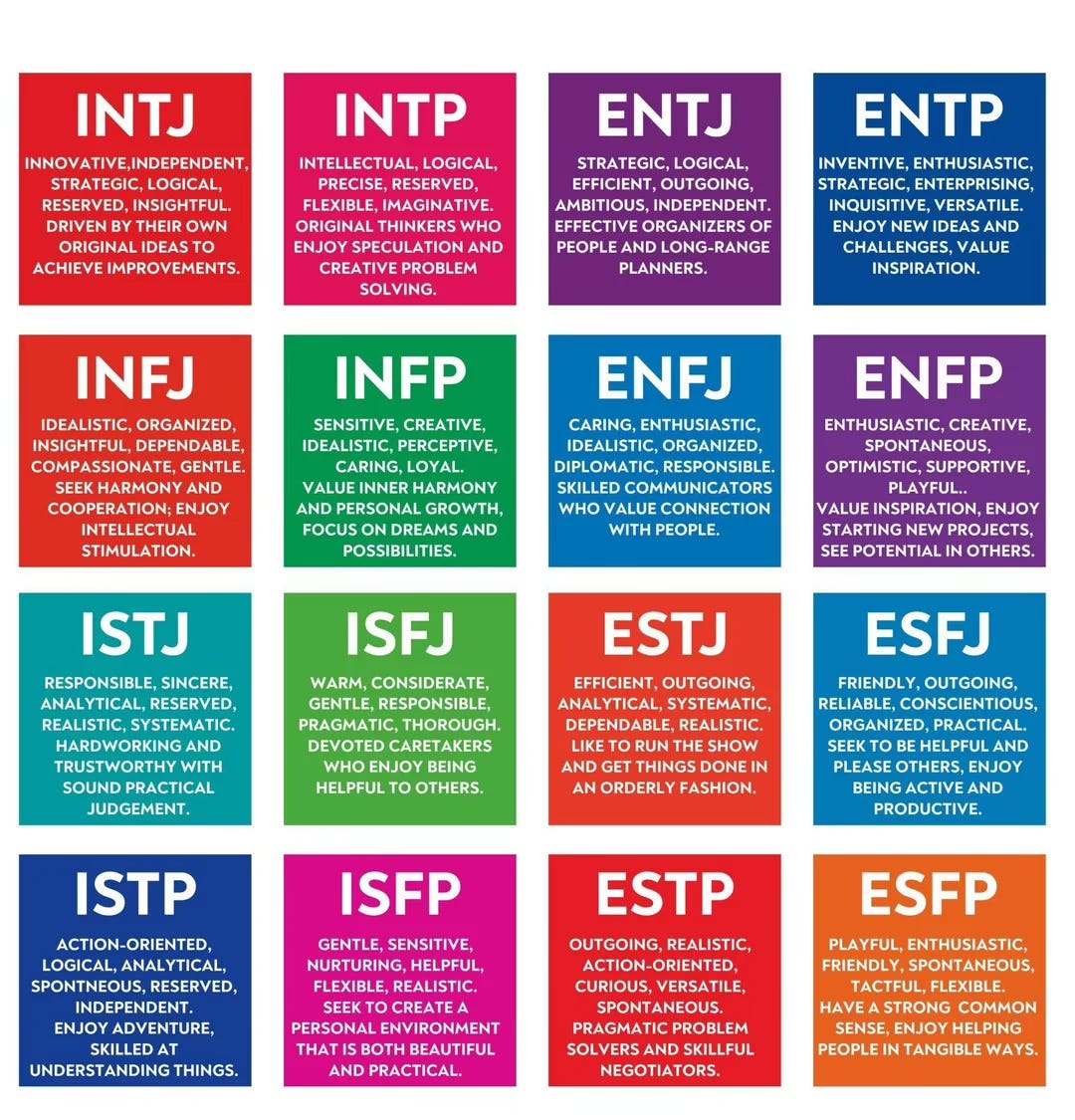
While the framework has its critics in academic psychology, it remains widely used in corporate settings, career counselling, and self-development contexts because it gives people a vocabulary for discussing cognitive differences without implying that any type is better or worse than another.
If you want to find out your personality type, you can take this brief, free online test. (No email or personal data required. Note that I have no affiliation with this site)
The Personality Types Dominating in Bitcoin
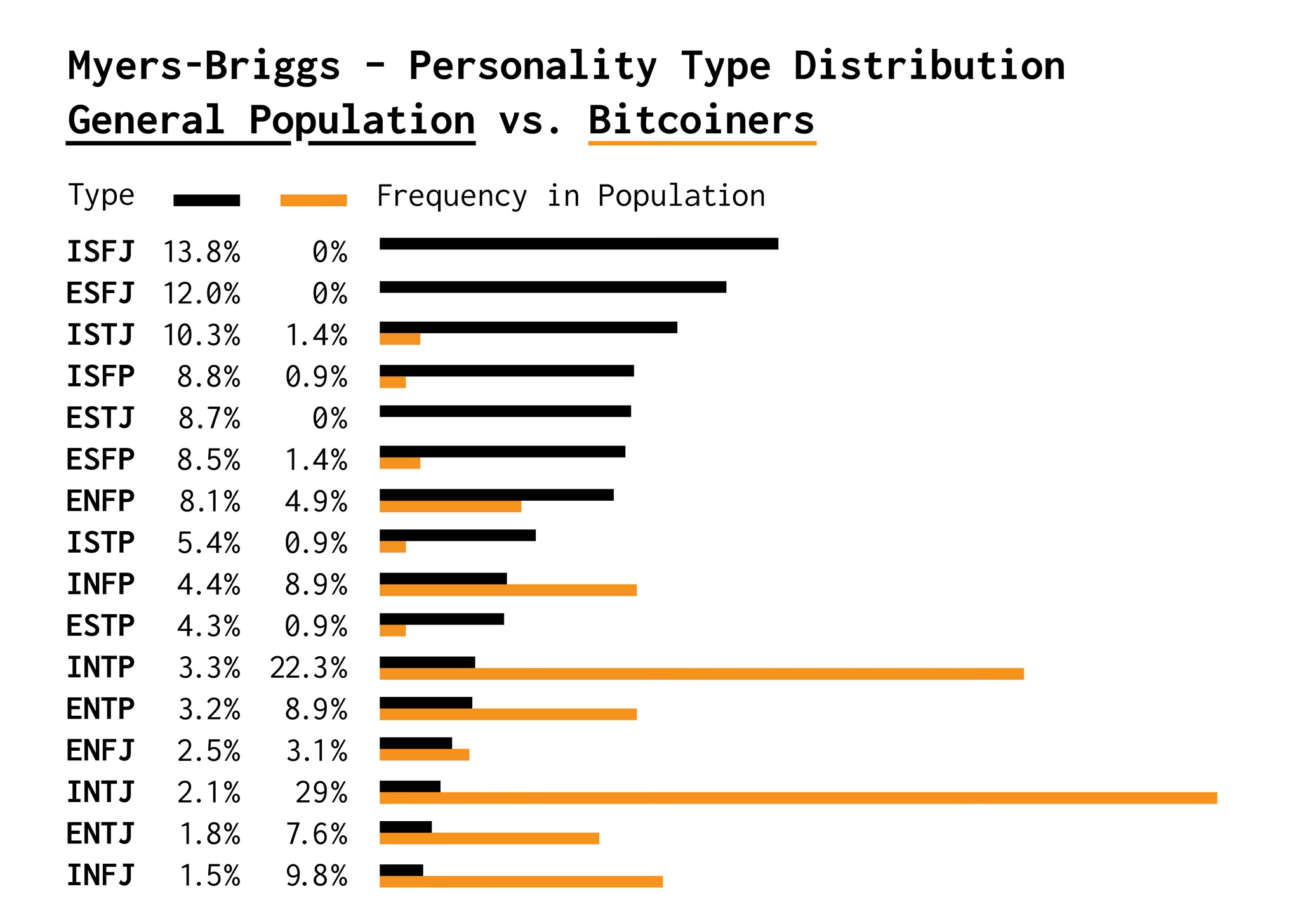
INTJ and INTP personality types make up just 5.4% of the general population. However, amongst Bitcoiners surveyed, they represent over 51%. That’s nearly a 10x overrepresentation.
Meanwhile, the four most common personality types in the general population (ISFJ, ESFJ, ISTJ, ESTJ) account for about 45% of the general population, but only 1.4% of Bitcoiners.
Both INTJ and INTP types are characterised by independent thinking over social consensus. They’re pattern recognisers drawn to complex systems. They tend toward scepticism of established institutions, and prefer first-principles reasoning to “this is how it’s always been done.”
Bitcoin rewards exactly this kind of thinking. It requires you to question money itself, something most people never do and have no interest in doing.
INTJs are described as innovative, strategic, logical, and driven by their own original ideas. INTPs are intellectual, precise, flexible, and drawn to speculation and creative problem solving.
Both types are comfortable being out of step with mainstream opinion. They don’t need social validation to hold a position.
This matters enormously for Bitcoin, where the typical journey involves years of being told you’re wrong, naive, or in a cult by friends, family, and financial professionals. Most personality types find that social friction unbearable.
For INTJs and INTPs, standing in opposition to social consensus is not so much of a problem.
The Intuitive/Sensing divide
Perhaps the most significant pattern in the data is the split between Intuitive (N) and Sensing (S) types.
Every type with an N is overrepresented among Bitcoiners. Every type with an S is dramatically underrepresented.
Intuitives focus on patterns, possibilities, and abstract concepts. Sensors focus on concrete, present realities and proven methods. Bitcoin requires you to think abstractly about what money is and what it could be. That’s simply not how Sensing types typically engage with the world.
The absence of certain common types
ISFJ, ESFJ, and ESTJ showed 0% among Bitcoiners despite being three of the five most common types in the population (combined 34.5%).
These are types characterised by tradition, duty, social harmony, and practical helpfulness within existing systems. They’re not drawn to questioning fundamental assumptions about how society organises itself.
They make communities function. They keep institutions running. They’re the reason your local council actually gets things done.
They’re just not very likely to spend their free time reading about monetary history.
The rarest personality type
INFJs are the rarest type in the general population at just 1.5%, but they showed up at 9.8% among Bitcoiners. That’s a 6.5x overrepresentation.
INFJs are idealistic, insightful, and principled. They’re drawn to causes they believe will improve the world. The “Bitcoin fixes this” idealism clearly resonates beyond pure systems-thinking types. For INFJs, Bitcoin may represent something more than an interesting technical or economic puzzle. It represents a path toward a better world.
Introverts dominate
Adding up the numbers, introverts massively outnumber extroverts among Bitcoiners (roughly 63% vs 37%), despite being a minority in the general population.
Bitcoin’s solo rabbit hole journey, the self-custody ethos, and the “low time preference” culture all favour people comfortable with solitary, long-term thinking over social consensus. You don’t need to convince anyone else. You just need to verify it yourself.
The gender divide
The personality types that dominate Bitcoin also happen to be disproportionately male in the general population.
The most pronounced gender difference in Myers-Briggs is the Thinking/Feeling dimension. Around 70% of women score as Feeling types compared to roughly 40% of men. This means Thinking types, who make decisions based on logical analysis rather than values and interpersonal considerations, skew heavily male.
INTJ and INTP are both Thinking types. Some estimates put INTJs at roughly 3:1 male to female in the general population, and INTPs at around 4:1.
This adds another layer to understanding why Bitcoin remains so male-dominated. It’s not simply that men are more interested in technology or finance. The personality types most naturally drawn to Bitcoin’s particular combination of traits (abstract systems thinking, comfort with social contrarianism, preference for independent verification over authority) are themselves more commonly found among men.
This makes women less likely to adopt Bitcoin. It also suggests that the current path into Bitcoin, the one that works for INTJs and INTPs, may not be the path that works for everyone.
The rabbit hole that delights a Thinking type might feel alienating to a Feeling type who wants to understand how Bitcoin helps real people in their daily lives.
You may also like…
How Bitcoin Rewires the Way You Live

If you think Bitcoin is about getting rich, you’ve missed the most important part.
What does this mean for adoption?
This data helps explain why attempts to orange-pill your friends and family so often fails.
The Bitcoiner making the case is statistically likely to be an intuitive introvert using abstract reasoning and systems thinking. The person they’re talking to is statistically likely to be a sensing type who values concrete evidence, social proof, and traditional authority endorsement.
They’re essentially speaking different languages.
What convinces an INTJ (rigorous logic, systems analysis, first-principles arguments) may actively alienate types who respond better to community validation or expert consensus. Telling someone “don’t trust, verify” lands very differently depending on whether that person already moves through the world that way.
The problem of INTJ/INTP
INTJs and INTPs can be dismissive of concerns they consider irrational. They can be impatient with people who need social proof before adopting a position.
They’re prone to assuming others will eventually “get it” if presented with enough logic. Because, after all, that’s how they make sense of things.
This has shaped Bitcoin culture in ways that aren’t always helpful for broader adoption.
The tendency to call people “NPCs” (non-playable characters) or to mock those who don’t understand Bitcoin reflects a communication style that works well among fellow intuitives but tends to alienate potential adopters.
A different approach
Rather than concluding that most people simply can’t understand Bitcoin, we might ask what Bitcoin education would look like if it were designed for different personality types.
What would resonate with ISFJs, who value helping others and practical reliability? Perhaps framing Bitcoin as a way to protect family members from currency debasement, or emphasising the reliability of a network that has never been hacked.
What would reach ESFJs, who value community and proven social benefit? Perhaps stories of how Bitcoin has helped real communities, or evidence of institutional adoption that signals social acceptability.
The challenge isn’t that other personality types are incapable of understanding Bitcoin. The challenge is that Bitcoiners are largely one type talking to themselves in their own language.
Where do you fit?
If you’ve already read this, you may well be an INTJ or INTP. The survey data suggests better than even odds.
Let me know in the comments if you fit into one of the common ‘Bitcoin personality’ types. You can do a free test here (no email or personal data required. Note that I have no affiliation to this site).
But if you found your way to Bitcoin despite not fitting that profile, your perspective might be valuable. What helped you get here? What arguments or framings worked for you that might work for others like you?
The path to broader adoption may depend less on better technical arguments and more on learning to speak to people whose minds might work differently than ours.

⛔️ FINANCIAL DISCLAIMER: This content is for informational and entertainment purposes only and should not be considered financial, investment, or legal advice. I am not a licensed financial advisor, accountant, or investment professional. The information shared in this post reflects my personal opinions and is based on publicly available data at the time of writing. All investment decisions—especially those involving Bitcoin or other digital assets—carry risk and should be made only after conducting your own due diligence and consulting with a qualified financial advisor. Never invest more than you can afford to lose. My views are my own and do not reflect those of any of my affiliate partners or sponsors.
Proud INTJ Bitcoiner here!
Excellent synopsis Katie. It also clarifies, for me anyway, why the minority of people globally rejected the popular zeitgeist of 2020 that instructed humanity to take an experimental injection for a pie-in-the-sky "new" virus in order to "save humanity".