

The Bitcoin Chain Split - The Death of BIP-110
Yesterday, Bitcoiners witnessed the first chain split in 9 years - and it was an abject failure. So what happened, how does it affect Bitcoiners, and what lessons were learned from this event?


This weekend, the Bitcoin network split into two chains.
Briefly, there were two versions of the Bitcoin blockchain: the main chain, which has been chugging along since 2009, and the new BIP-110 chain, which died after only two blocks were mined.
At the time of writing, the BIP-110 chain is 112 blocks behind the main chain. At this point, there is no way for it to catch up.
For those who missed the 2017 blocksize wars, an event that eventually resulted in two different versions of Bitcoin - Bitcoin Cash and Bitcoin SV - this was a front row seat to witness a failed fork in real time.
My position
I want to be clear. I do not intend to take a stance on whether this is a ‘good’ or ‘bad’ outcome. I decided some time ago to take the ‘Swiss’ approach to this event and remain neutral.
While I am a Bitcoin monetary maximalist and a Knots node runner, after digging into the topic, I realized I simply did not have the knowledge or experience to understand if I should support BIP-110.
So I left my node running Knots but did not upgrade to BIP-110. I decided to sit back and observe this time. I was not around during the blocksize wars and had not seen any event like this play out in Bitcoin before.
My goal here is to explain, in the simplest terms possible, exactly what happened, what it means for Bitcoin (and you as a Bitcoiner), any action you may need to take, and what we should learn from this.
What I cover in this article:
What exactly is a BIP?
What BIP-110 set out to achieve
Why BIP-110 was so contentious and divided the Bitcoin community
What happened yesterday when it activated
Why the BIP-110 chain is now orphaned
How this event was similar to (and different from) the Bitcoin Cash/SV split
The lessons Bitcoiners can learn from this failed fork
What you should do right now as a result
So what is a BIP, anyway?
‘BIP’ in Bitcoin stands for ‘Bitcoin Improvement Proposal’. A BIP is a formal, written proposal to change Bitcoin’s underlying protocol (rules).
A BIP can be proposed by anyone. However, BIP proposals are just that - proposals. They are not the codification of a change in the way Bitcoin functions.
Recent well-known BIPs were BIP-340, 341 & 342 - otherwise known as ‘Taproot’. Without getting excessively technical, Taproot was an upgrade to Bitcoin’s signature and scripting system to improve privacy and efficiency.
What BIP-110 set out to achieve
BIP-110 was a result of the recent update to Bitcoin Core node software (Core v.30) that removed the OP_RETURN limit and therefore made it easier to stuff arbitrary or non-monetary data (text, images) into transactions.
BIP-110 proposed a temporary fix (known as a ‘soft fork’) that was intended to last around a year and would place a limit on non-monetary data that could be included in transactions. Anything already on the chain before activation would be grandfathered in.
Ultimately, the goal was to prevent the network from filling up with data that was unrelated to sending or receiving money, since every Bitcoin node is required to store it forever.
Why was BIP-110 so contentious?
If you spent any time on the toxic swamp of social media known as X, you would have seen the vitriol slung across the divide, in both directions.
The BIP-110 crowd vs the status quo folk. Bitcoiners against Bitcoiners. Every man, woman, and their pet dog had an opinion, and by God, they were going to share it.
In simple terms, the two camps were this: the BIP-110 side said that all the arbitrary data is clutter that every node runner has to store forever, while the other side claimed that if you paid for the space, you can use it as you wish - Bitcoin doesn’t play favorites.
Critics pointed out that BIP-110 only needed a much lower bar of miner support to go live (55%), compared to Bitcoin’s very-high-agreement standard (95%), hinting its backers weren’t expecting to win over the majority.
Supporters argued that only a real protocol-level rule change, enforced by consensus, could make the data restrictions stick network-wide. Otherwise, they would remain optional and thus easily ignored.
Before BIP-110, node operators could set their own local policies discouraging this kind of data (e.g., running Knots and enforcing the OP_RETURN limit), but miners weren’t obligated to respect them. A miner could still include it in a block as long as someone was willing to pay the fee.
What happened when BIP-110 was activated?
In simple terms, at block 961,632, mined yesterday on August 8th, 2026, the rule kicked in: every node running Bitcoin Knots with BIP-110 enabled would now reject any block that didn’t include the required signal.
Almost no miners signaled for BIP-110. Support peaked at 2.32%, nowhere near what was needed to bring the network along without a split.
Most miners just carried on as normal, while Ocean broke off and started building a separate version of the chain that enforced the new rule.
However, after mining the first and second BIP-110 blocks, Ocean then mined a ‘non-compliant’ block on the main chain.
From the moment that the two BIP-110 blocks were mined by Ocean, two competing versions of Bitcoin’s history existed side by side. The BIP-110 version, however, was short-lived, stalling out at block 961,633.
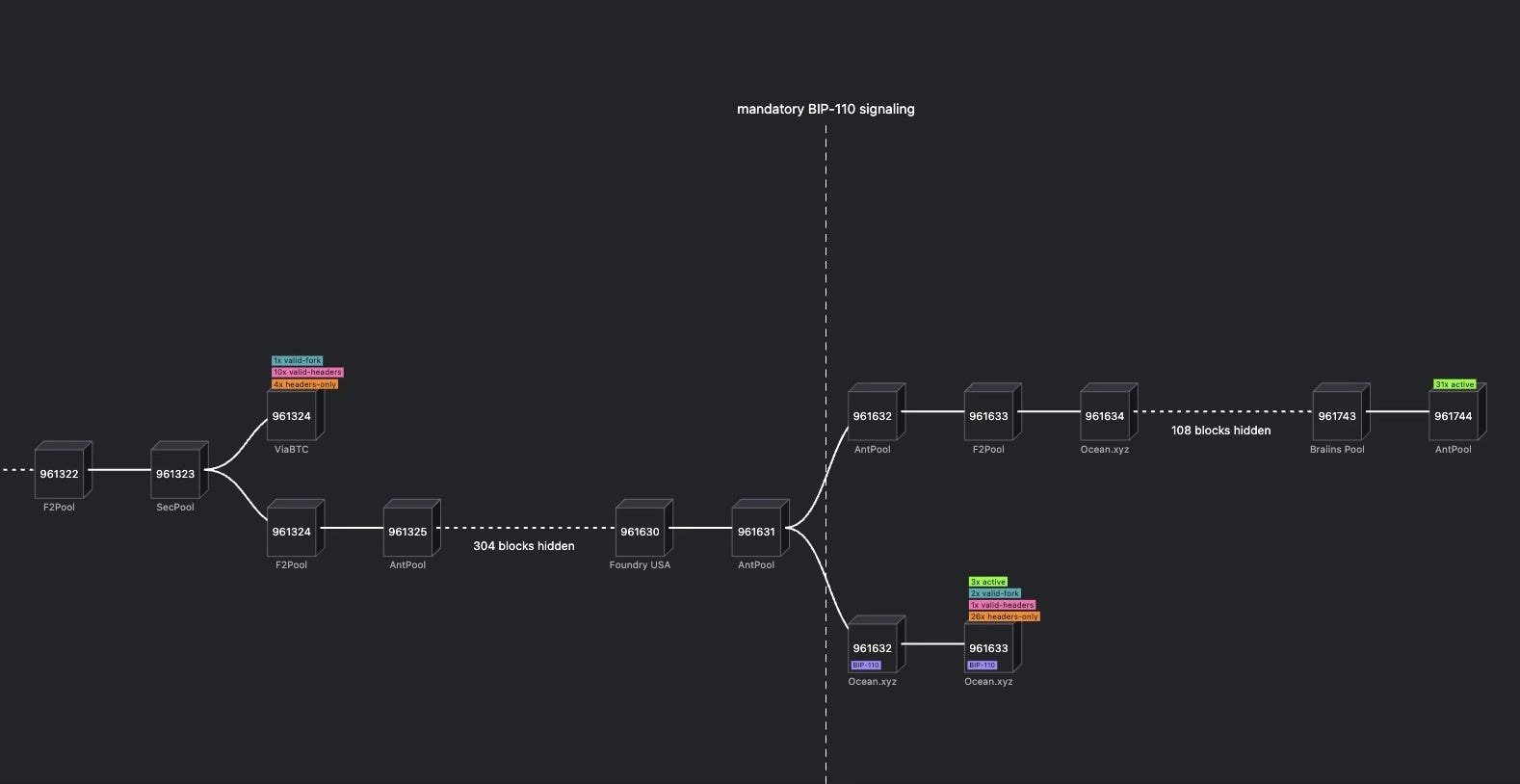
You can see a live visual representation of this chain split here:
https://fork.observer/?network=mainnet
Changes like this only stick if the entities that actually confirm the transactions agree to them. And in the case of BIP-110, by and large, the miners did not agree.
You may also like…
This week, nothing happened to Bitcoin

Picture this. You’re standing on a bathroom scale on the deck of a boat in a storm.
Why did the BIP-110 chain grind to a halt?
The new BIP-110 chain managed just two blocks before stalling, while the main chain kept adding a new block roughly every ten minutes as usual. This meant it pulled dozens of blocks ahead within hours.
