

If Bitcoin's Price Drop Scares You, Read This
Bitcoin has seen a 50% drawdown from the all-time high, and here's why that changes nothing about what you hold

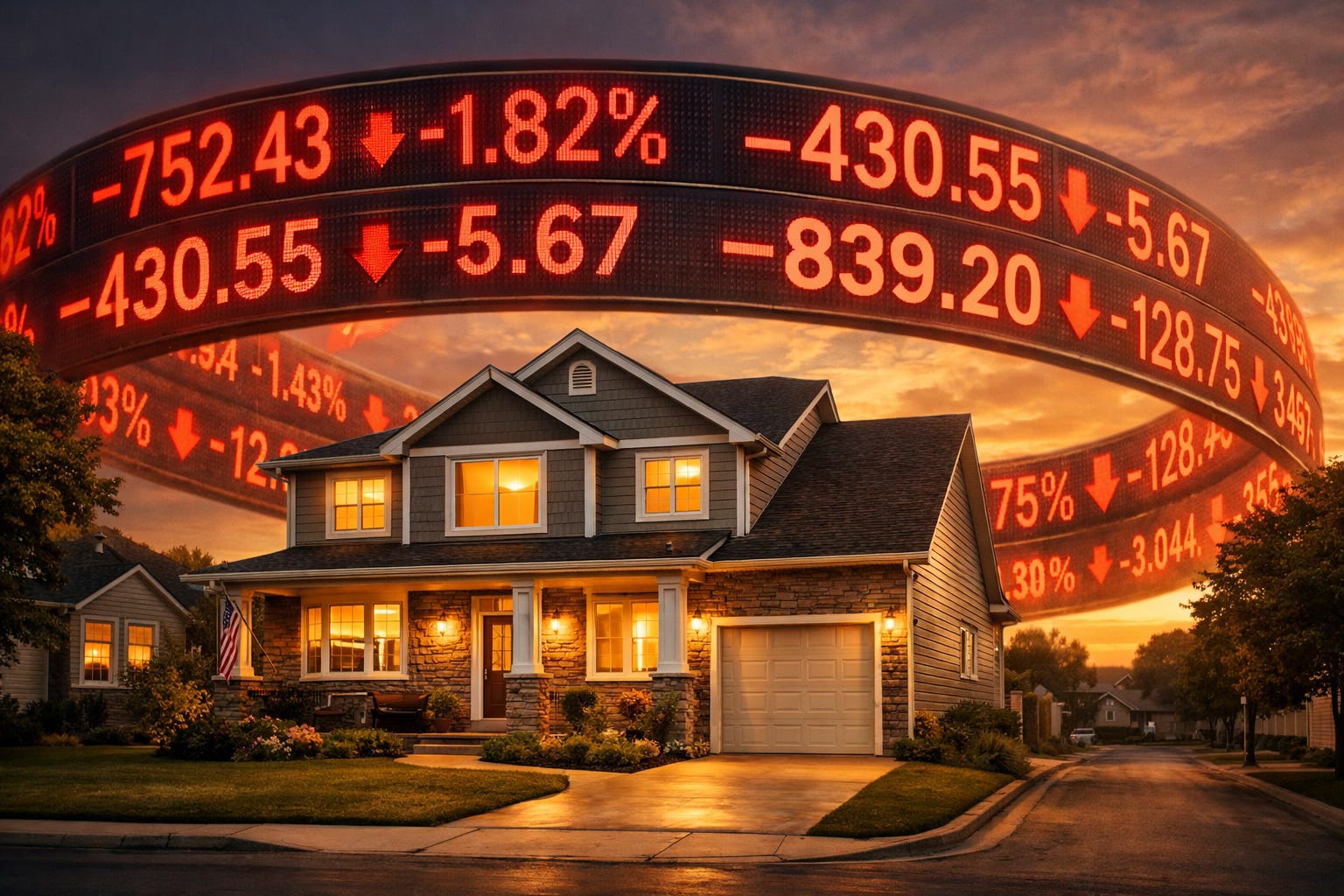
If the real estate market crashed tomorrow and your home’s assessed value dropped by 50%, would you immediately put it on the market and move your family onto the street?
My guess is that the answer is a resounding ‘No!’
Your kids are still sleeping in their beds. The heating still works. The roof still keeps out the rain. The neighborhood is still yours. You’d look at anyone who suggested panic-selling your house as if they’d lost their mind.
So why do so many people treat Bitcoin differently?
Your house is still the same
If you owned a home in 2008, maybe you already know how this feels. Perhaps you’re one of the millions of people who watched your home’s assessed value drop by 30%, 40%, even 50% during the financial crisis. It was gut-wrenching.
But your home’s value was never just its resale price. It was shelter, stability, safety, and a sense of belonging that existed completely independently of what Zillow said it was worth on any given Tuesday.
The roof kept doing its job regardless of what a hedge fund did. The foundation held firm regardless of what happened to mortgage-backed securities.
Your Bitcoin works the same way. But how, you might ask? I can’t live in my Bitcoin. That’s not an accurate comparison.
What we are comparing here is the utility value. Bitcoin serves a very different function that a house does, but the important point is that value extends beyond how many dollars you can exchange it for.
Bitcoin’s dollar price dropped from roughly $126,000 in October 2025 to around $69,000 today. But the thing itself, the actual asset you hold, remained completely intact. Every bit. Every sat. The network is still minting a new block every ten minutes.
So the question then becomes - what IS Bitcoin’s value beyond the number on a price chart?
In this post:
Why price and value are two completely different things (and why confusing them costs you money)
What the Bitcoin network actually did while the price was falling
How Lehman Brothers, Enron, and Wirecard demonstrated that assets measured only in fiat dollar terms for shareholders can be risky
The dollar as a shrinking ruler: what your portfolio looks like measured in purchasing power
Why the macro conditions behind this drawdown strengthen the case for Bitcoin, not weaken it
What this means for you, and a practical action list for surviving a drawdown without stress
Price and value are two different things
Let’s start with price vs. value.
When it comes to Bitcoin (and other hard assets), these are not the same thing.
Sure, they can be the same thing, since price is one way of measuring value. But in the case of assets that offer intrinsic or other use value to the holder, price isn’t the only consideration.
Price is what someone is willing to pay for something at this exact moment in time. It’s driven by sentiment, leverage, liquidations, and whether Donald Trump tweeted before breakfast. Price is like a mood ring. Price fluctuates with the human fear and greed.
Value is what the asset actually does for you. What properties it has. What problems it solves. What options it gives you that you wouldn’t otherwise have.
Your 1 BTC is still 1 BTC. And that 1 BTC still does everything it did in October 2025.
It still has a hard cap of 21 million coins. Nobody printed more while you were sleeping. It still settles transactions anywhere on earth without permission from an intermediary such as a bank or government.
It still can’t be frozen, seized, or censored. And you can still hold it yourself, in your own custody, without relying on a single institution to safeguard it for you.
Nobody can inflate your share away. As long as you continue to self-custody, nobody can seize it. And nobody can decide you don’t deserve access to your own wealth.
Those properties are all permanent features of the Bitcoin protocol.
The network only knows one thing: keep running
Here’s something that should help to reframe how you think about this drawdown entirely:
While Bitcoin’s dollar price was falling from its October high, the network itself was getting stronger. Measurably, verifiably stronger.
In December 2025, Bitcoin’s hashrate crossed 1 ZettaHash per second for the first time in history. That’s one sextillion calculations per second being performed to secure the network. The most computational power ever directed at protecting a single system.
Blocks kept getting mined roughly every ten minutes. Transactions kept getting settled. The protocol kept running, 24 hours a day, 7 days a week, 365 days a year, just like it has every single day since 2013 without any downtime. Bitcoin’s total network uptime now exceeds 99.99%.
To put that in perspective, that’s more reliable than Google. More reliable than Amazon Web Services. More reliable than any bank, exchange, or government payment system on the planet.
Let’s go back to the house analogy for a moment. Imagine that during the price crash, someone came in and reinforced the foundation, upgraded the plumbing, and added a new security system - all while the market was panicking.
That’s what happened to Bitcoin’s network during this drawdown.
Now compare that with other assets
When mainstream financial media and critics tell you that Bitcoin is “speculative,” they’re revealing something important about how they define value. To them, an asset’s value IS its price. And if the price is volatile, the asset must be risky.
But let’s apply that logic to the assets they once considered safe and legitimate.
